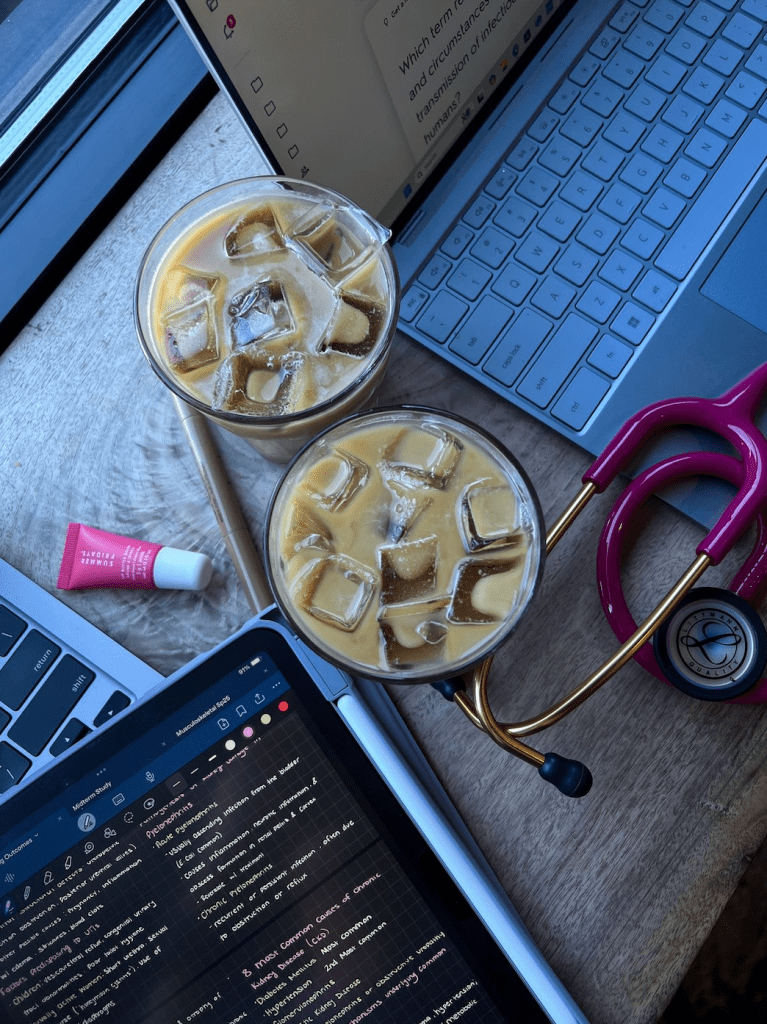
Nursing school gives you a lot of information. So much that sometimes you don’t even want to ask a question, because you’re afraid the answer will just be more information you don’t know what to do with yet. But one of the biggest shifts for me wasn’t learning more — it was learning how to look at information through the lens of my profession.
That part took some time.
I came into nursing school with a bachelor’s degree in neuroscience, where my entire academic identity was built on understanding the nitty gritty, molecular, teeny tiny details. If I couldn’t trace the pathway, from receptor binding to ion flux, changes in membrane potential, and the resulting effect on neuronal firing, I felt like I didn’t really understand the material. That worked great in neuroscience. It did not translate cleanly to nursing school.
I remember sitting in front of my first pharmacology exam thinking, Where are the questions asking me to explain how diuretics inhibit sodium reabsorption along the nephron, or how a beta-blocker like metoprolol lowers heart rate by blocking β₁-adrenergic receptors? Instead, I hit my nth question about adverse effects. Questions I was half guessing on, and it clicked: I had approached this completely wrong.
I had trained myself to chase mechanisms all the way down, but nursing school wasn’t asking me to stop at the “how.” It was asking me to know what that mechanism means for a real person: what to monitor, what side effects to anticipate, and when a medication could become unsafe. While I thought I was over-prepared for the exam by studying deeper than what was asked, I had essentially screwed myself.
letting go of “i need to know everything”
This was honestly the hardest part for me. In my neuro classes, the goal was understanding for the sake of understanding. My professors didn’t want me leaving the room without being able to explain a synapse at a molecular level, and I wanted that!
But my nursing professors have a different goal. They want me to safely administer medications. They want me to recognize human responses. They want me to know when something is wrong and what to do about it.
So now, when I study, I still start with underlying mechanisms (because that’s just how my brain works) but I do it with intention. I aim to understand the mechanism well enough to predict patient responses and guide safe nursing decisions without disappearing into details that won’t change my care at the bedside.
Not because the details aren’t interesting, but because they’re no longer the priority. And I have to trust that they will come later with practice.
That shift alone pulled me out of the “I need to know everything ever or else I know nothing” hole.
what my studying actually looks like now
This is the system I’ve landed on after a lot of trial, error, and some uncomfortable learning curves.
Before class
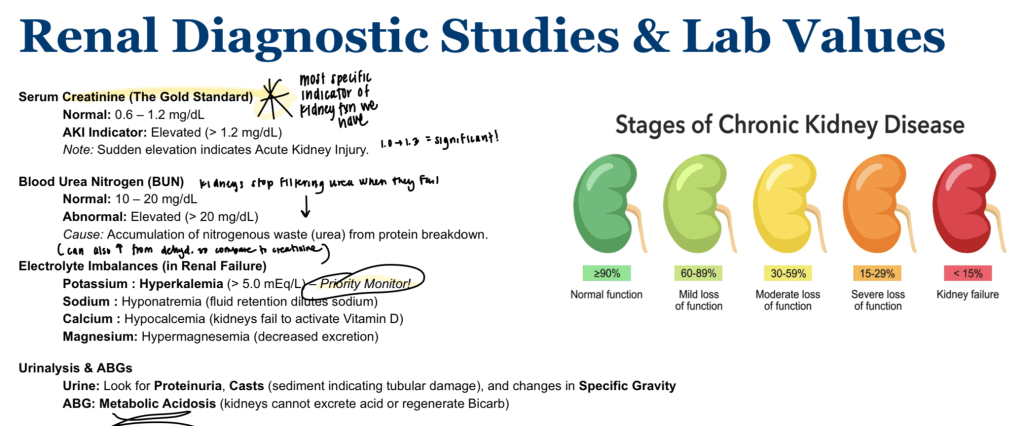
If instructors post slides ahead of time, I skim through them and lightly pre-annotate; nothing intense, just enough so the material isn’t brand new (For pharmacology, I’d go pretty in depth). This is pretty specific to my program, but we have asynchronous video lectures before our live lectures (accelerated master’s problems), so I watch those and annotate the asynchronous slides as well.
During lecture
I annotate directly on the slides or type in a doc as we go. I don’t try to write everything down because typing what’s already on the slide isn’t efficient when I can always review it later. Instead, I focus on capturing the new ideas the professor adds in real time. I listen for emphasis and note what gets repeated.
Immediately after class (it’s hard to stay consistent with this, but SO worth it!)
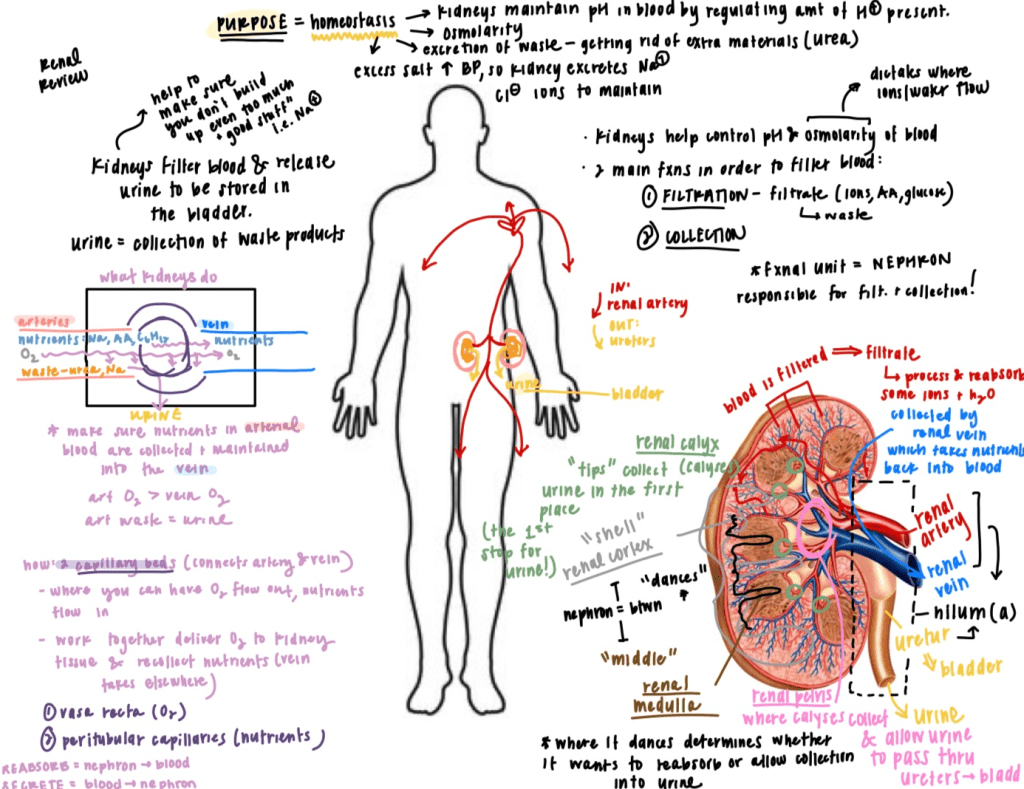
I take the learning objectives that can usually be found in the syllabus or the beginning of the slides; textbook is another option, but it is better to understand the objectives of the person writing your exam. I then write out everything I can remember without referencing outside materials, other than a quick glance at my notes. Most of the time this turns into a diagram or concept map.
Anything I can’t piece together myself, then I reference the textbook.
Confession: I’m not a textbook girlie. I use it when I need it, but it’s rarely my starting point. Forcing yourself into study habits that don’t actually support how you learn usually just leads to burnout faster.
Having a system in place where I only read what’s crucial saves me a huge amount of time and it also keeps me honest. I know myself well enough to admit that if I don’t understand something on the first pass, I can get a little avoidant. This approach forces me to at least go read about it, breach the surface, and get oriented, which always puts me in a much better position moving forward.
Next step: synthesizing
Later (usually the weekend), I take my handwritten or typed notes, slide annotations, and learning-objective diagrams and type them out into one cohesive set of notes.
I don’t actually think rewriting notes magically helps me memorize things, but it does help me synthesize:
- my thoughts
- the lecturer’s emphasis
- and the textbook’s framing
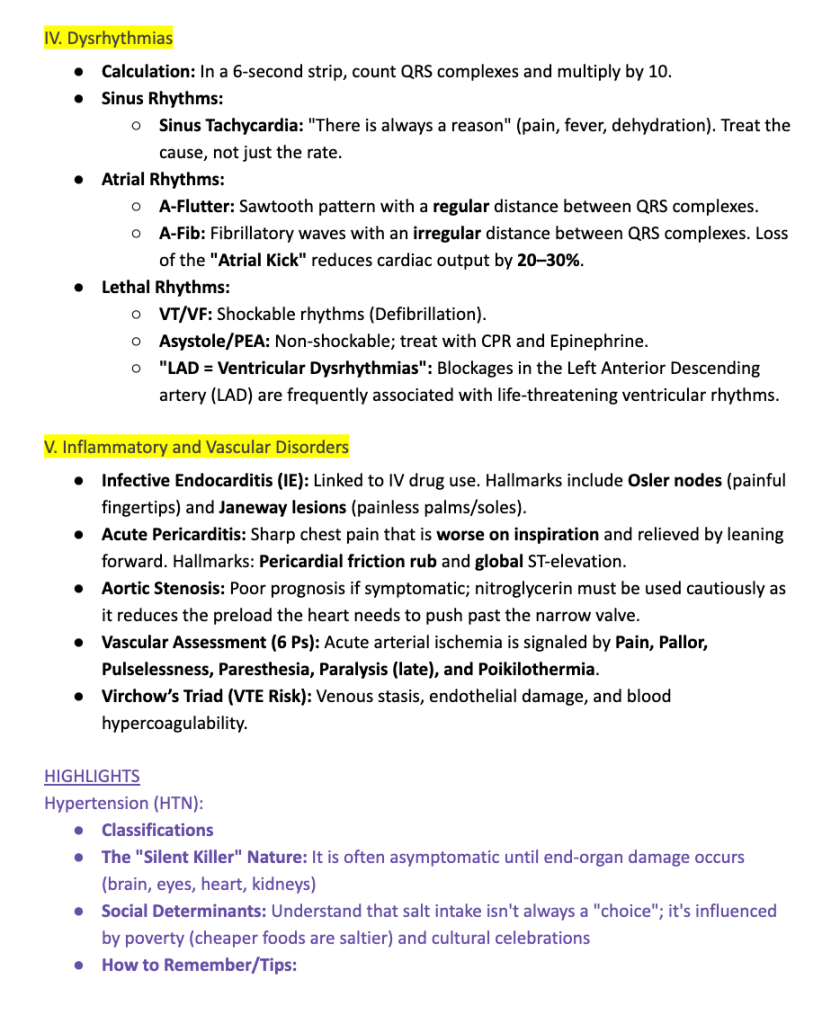
More importantly, this typed document becomes the foundation for what comes next.
where the real learning happens: practice questions
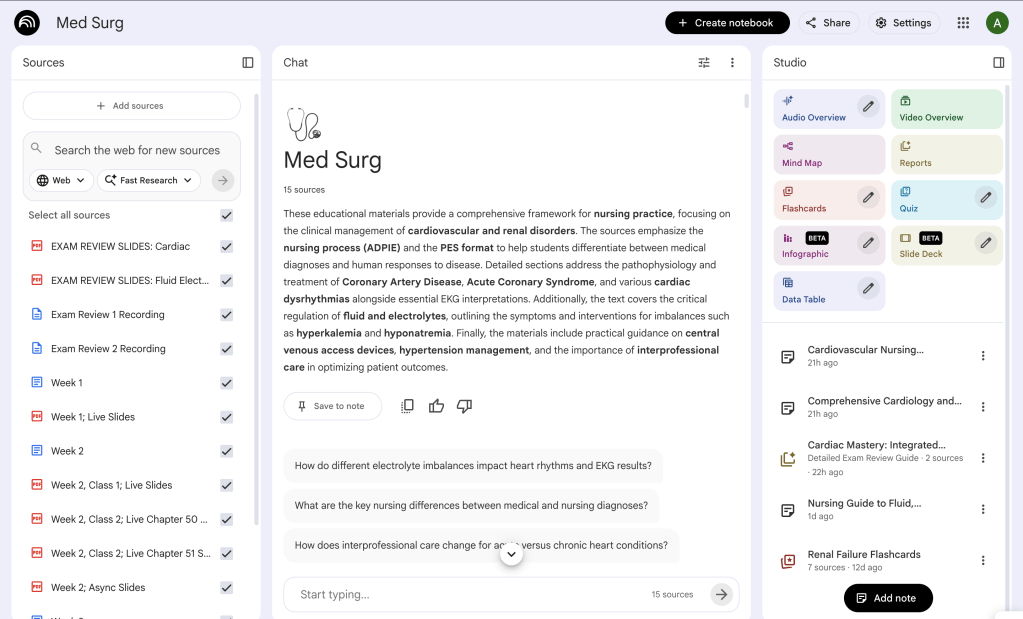
Yes, I use AI to generate practice questions from my notes. Yes, I will accept my fate if that makes me a terrible person. Because also YES, it generates NCLEX-style questions based directly on my exam content.
This is where things actually stick.
I can read something ten times and it won’t land. But the second I’m forced to apply it, the material starts to make sense.
Learning how nursing school asks questions is honestly half the battle and the more you expose yourself to the types of questions where every question is right…but you have to choose the MOST right, the better.
With every lecture, I keep adding to my typed notes and layering in more practice questions. If something still isn’t sticking, that’s when I make flashcards; not for everything, just for stubborn concepts. There have been three classes so far where flashcards played a major role for me.
In Foundations, I used them for concrete skills you just had to know: i.e. injection types, angles, locations, needle gauge, and technique.
Pharmacology was a flashcard-heavy class overall. I made cards for most medications, organized by drug class, mechanism of action, adverse effects, and nursing considerations.
And in Med-Surg, a similar approach to Foundations. i.e. electrolytes lived almost entirely on flashcards their normal ranges, what happens when levels are too high or too low, and nursing considerations.
learning to stop chasing perfection
For a long time, I avoided practice questions until too late because I thought I needed to “learn the material first.” If I couldn’t understand every single detail, I felt behind.
Now I try to accept that I won’t understand everything immediately and that’s okay.
By test day, I usually realize I’ve learned far more by building a solid, general grasp of all the topics than I ever did by deep-diving into one area and burning myself out. Instead of cramming the night before an exam, I spend that time doing full-length practice exams and using the results to guide where deeper review is actually needed.
the big picture
So, in short, my method looks like this:
- pre-class skim
- in-class slide annotating
- post-class learning objectives + concept mapping
- textbook only when needed
- synthesis + practice questions
- flashcards for what won’t stick
- khan academy for prerequisite refreshers
- ninja nerd for when I need someone to walk me through the big picture
It sounds like a lot…but so is thinking you can cram the entire textbook in the night before an exam. (yes, I was looking through your window last night).
This system got me through my first semester with some learning curves and has helped me hit my stride this semester while feeling more confident in how I’m learning. It’s less about doing everything perfectly and more about building a way of studying that actually feels sustainable.
A reminder from a student nurse moving at a reasonable pace:
learning how to prioritize is part of the practice.
— sloth in scrubs 🦥
 slothinscrubs
Leave a comment